For owner-operated firms · mid-market

The market sets the multiple ranges.Where you land is a function of choices.

Private equity already bought the big players. Now it's coming down-market - for firms like yours. The range your industry hands you isn't fixed; it's a starting point. We diagnose where you stand, quantify what's discounting you, and map the moves that reposition you into a higher-multiple peer group. Buy-side calibrated. No success fees.

Market intensity · 2024–2025

80%+
of lower-middle-market deals are now roll-ups or add-ons

PitchBook via Capstone / CapitalPad, FY2024 (4,908 bolt-ons tracked).

~$2.5T
in global PE dry powder waiting to deploy

S&P Global, mid-2025 (~$2.5T global private capital dry powder).

more PE buyers in fragmented service sectors than five years ago

Capstone Partners, fragmented-services roll-up tracking, 2024.

6–8×
the typical EBITDA multiple the lower-middle market hands you

J.P. Morgan Asset Management, lower-middle-market deal data, 2024.

The wave

PE rolled up the big players. Now it's working down-market.

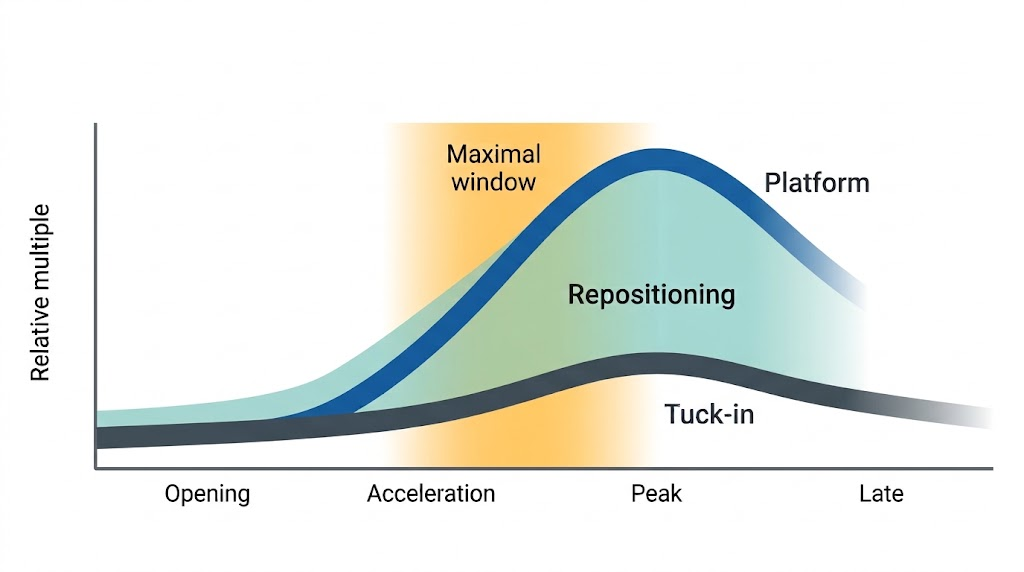
Industry after industry runs the same arc. The wave reaches the owner-operated tier last - and that's where the choice still exists. Wait too long and the platform on-ramp closes: you can only be acquired, not the one doing the acquiring.

Wave curve showing tuck-in, platform, and repositioned ranges across opening, acceleration, peak, and late phases of consolidation. A gold optimal-window highlight marks the closing platform on-ramp.
Illustrative · Three paths, one timing decision

Accounting

First PE-to-PE platform flip already happened - the late-cycle tell.

IT services / MSPs

Wave 2 closing; recurring-revenue books now priced separately from break-fix.

Architecture & Engineering

552 firms changed hands last year; international buyers entering the US.

HVAC & home services

Roll-up density past 60% in major metros; route density became the moat.

Veterinary & dental

Group ownership crossed a third of clinics; multiples bifurcated by chair count.

Insurance brokerage

Bolt-on tuck-ins running at record pace; platform multiples hitting double digits.

Environmental & testing

European platforms entering the market; new comp set on every deal.

Behavioral health

PE platforms forming around outpatient and ABA; the on-ramp is still open.

The owner's three decisions

Three blunt questions. One of them gates the other two.

Most owners answer them by default, not by design. Waiting doesn't just cost multiple - it deletes options, in order.

  1. 01When

    When will you act?

    Passive default

    Wait for inbound. Accept the window the market gives you.

    Ambition

    Move while the platform on-ramp is still open.

    Timing is the master decision - it gates the other two.

  2. 02Who

    Are you the one being rolled up, or doing the rolling up?

    Passive default

    Be a tuck-in. Sell at the prevailing tuck-in multiple.

    Ambition

    Build the platform. Acquire and integrate the tuck-ins yourself.

    Closes first when timing slips - you can no longer be the consolidator, only a target.

  3. 03Where

    Your industry's ceiling, or a higher one?

    Passive default

    Stay inside your industry's comp set. Accept its ceiling.

    Ambition

    Reposition into a higher-multiple peer group.

    The repositioning runway shortens with the window.

Not every owner can or should become a platform - capital, appetite, and timeline all bear on it. The read identifies which path actually fits your situation.

A reframe

Your multiple isn't a future exit number.It's a live grade on what you've built.

The multiple a buyer would pay today is the market's read on the quality of the asset you've already built - concentration, recurring revenue, owner dependency, leadership depth, backlog mix, the shape of growth. It's a grade, not a forecast.

Two firms with the same EBITDA and the same industry routinely land in very different places. The gap between them is rarely accident; it's the cumulative effect of a hundred small decisions made - or deferred - over the last five years.

The read tells you which decisions are quietly discounting you right now, and how many turns of EBITDA each one is worth.

The wedge

The range is a starting point, not a verdict.

The same business - same EBITDA, same people - is worth dramatically more as part of a scaled platform than as a small firm. That gap is what repositioning targets.

Multiple-arbitrage spread across mid-market sectors, grouped by consolidation phase. For each sector the typical small-firm EV/EBITDA range sits well below the scaled-platform range.
EV/EBITDA, illustrative · Small-firm range vs. scaled-platform range

What a read looks like

A redacted one-pager. Built from public data alone.

This is the shape of every complimentary read: a defensible starting multiple, every headwind quantified in turns of EBITDA, every driver mapped to a repositioned ceiling.

Multiple bridge - illustrative

5.0×
+3.0×
−1.0×
7.0–9.0×

As-is range

Value drivers

Value at risk

Repositioned

Built without contactNames redacted

Quantified value-at-risk · EBITDA turns

HeadwindTurns at risk
Top-3 client concentration above 40%−1.25
Owner-dependent business development−1.00
Thin layer below the founder−0.75
Project revenue with no recurring book−0.50
Value driverTurns of upside
Reposition into a higher-multiple peer group+3.50
Build a recurring services line+1.50
Install a second leadership layer+1.00

Illustrative. Real reads carry sourcing and a defensible range, not a single number.

Why this is different

Three seats. Almost no one has held all three.

01

Buy-side calibrated.

Five years inside an investment holding company, on the buy side of the capital that acquires firms like yours. The read reflects how acquirers actually price - not how a seller's agent hopes they will.

02

McKinsey & Company trained rigor.

Four years at McKinsey & Company. The analytical discipline behind the diagnosis: structured, defensible, primary-sourced where it matters.

03

Eighteen years in this seat.

Almost two decades focused on owner-led services businesses. Pattern recognition is the unlock - and you don't get it from a framework, you get it from the reps.

Against the alternatives

  • Brokers & transaction advisors

    Paid when a deal closes. Their read is event-driven and incentive-conflicted; they have no reason to actually improve the asset, only to move it.

  • Generalist consultants

    Framework, but no capital-markets seat. They've never priced a firm as a buyer, so the multiple is theoretical.

  • Multiple Forge

    Owner-aligned (no success fee), strategic (a live read, not an exit event), buy-side-calibrated. A different thing.

What we are · what we're not

The trust spine.

What we are

  • -Fixed fees, set before work begins.
  • -Owner-aligned: no success fee, no transaction participation, no back-end.
  • -Useful whether or not you ever transact - the value is in the data and the strategy.
  • -Held in confidence; project-codename system internally.

What we're not

  • -Not a broker. We don't shop your firm.
  • -Not an investment banker. We don't run processes.
  • -Not a generalist consultant. We don't do off-the-shelf strategy decks.
  • -Not a vendor of yours to your eventual buyer.

Who this is for

Selective on purpose.

The methodology is built for a specific kind of owner. Naming it up front saves us both time.

Fits

  • Owner-operated, founder-led, or founder-adjacent firm.
  • Roughly $2M–$50M EBITDA. Mid-market.
  • Some kind of transition on the horizon - exit, recap, succession, platform play - even if the timing is open.
  • Genuine appetite to act on what the read surfaces. Not just curiosity.

Doesn't fit

  • ×Pre-EBITDA or pure venture-stage.
  • ×Public companies or PE-owned platforms already inside a process.
  • ×Owners who only want a number to validate a decision already made.

Soft ask · self-segment

Want a read on your own situation?

Pick your industry. We'll route you to the right starting point - a vertical page where one exists, or directly into the complimentary read where it doesn't. Useful regardless of whether we ever talk.

opening

acceleration

peak

late

Opening · runway
Acceleration · in the window
Peak · window closing
Late · platform on-ramp closed

Hover or tap a marker to see where the industry sits - and one piece of evidence behind the placement.

My industry isn't here →

Useful regardless · No success fees

The operator behind the method

Jon Rothbart, founder of Multiple Forge.

Delivered by Jon Rothbart. Backed by data and a proprietary methodology engine.

Jon spent over two decades as an executive of Afrocentric - a diversified investment holding firm - and as a strategy consultant. In that time, he reviewed several hundred private companies for acquisition. Most were rejected. The reasons were patterned and repeatable, and the patterns became the spine of a methodology for the owners on the other side of the table.

Multiple Forge is a practice dedicated to one question: how do owner-led services businesses become the kind of platform a strategic buyer pays a premium for? The buy-side lens is industry-agnostic; vertical-specific applications live under sibling sites.

The team-of-six analysis pyramid has been replaced by a methodology engine. Jon directs every engagement personally. The engine produces the artifacts - faster, cheaper, at consulting-grade quality.